Thursday, July 28, 2011

Understanding Vastu Shastra

It is amazing to know that the Vastu principles discussed in our ancient books are built upon solid foundations of science, to provide all round prosperity for the dweller. In this article, I will cover the scientific basis behind the core Vastu principles.

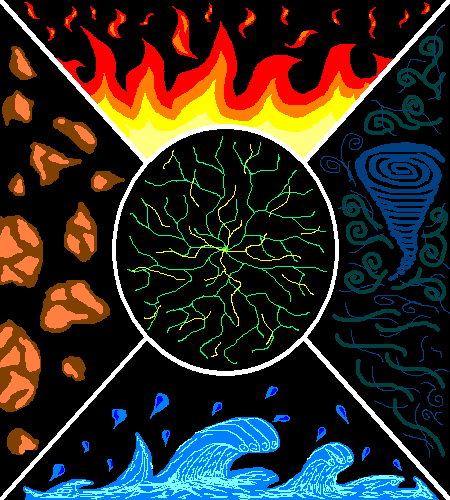
The entire life in our Universe is based on the five elements: Fire, Earth, Air, Water and Sky. These five elements are found everywhere and anywhere. Even our bodies are composed of these five elements. When any of these elements happen to be in excess or less in our body, the result will be physical or psychological problems. For example, if Fire element is more, we will get physical problems like high BP, insomnia, ulcers and psychological problems like anger and tensions. When Water element dominates, it leads to laziness, hallucinations, fickle mindedness, obesity and indigestion. Vastu is a science of architecture which is aimed at balancing these five elements. 
Understanding the elements:

In our solar system, the Sun provides life by giving enough light and heat which makes life possible on Earth. This is the reason our Vedas and Upanishads praised the Sun as the supreme soul (God). Sun rays travel through the Sky and reach our Earth. Thus the Sky element is the carrier of life energy. Sky element should be enough to carry abundant life force into our house.

Before constructing a house or building, we should take the measurements of the plot or land. The Sky element is 9% of the length and 9% of the breadth around the plot. For a plot with 60 ft length and 50 ft breadth, we should leave around 5.4ft along the length and 4.5ft along the breadth as Sky element. The Sky element surrounds the entire house something like a box. Remember, the actual construction should be done after deducting space for Sky element. So the actual construction length will be 60-5.4 = 54.6 ft and breadth will be 50-4.5 = 45.5 ft.

We should leave space for the Sky element around the house or building. The Sky element can be kept more by leaving more space around the house or building. In that case, we should leave more space towards East and North directions. It means a house or building should be constructed towards the S-W direction of the plot.

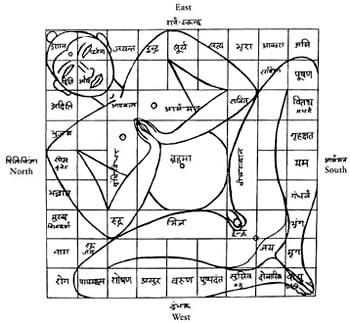
After deducting space for the Sky element, only the remaining area (54.6 X 45.5) should be used for actual construction. This area should be divided into 4 equal parts of each 25%. Part 1 starting from middle of North till middle of East is represented by Water element. Part 2 from the middle of the East side to middle of South represents Fire element. Part 3 from middle of South till middle of West represents Earth element. Part 4 from middle of West to middle of North represents Air element.

After finding the elements in the plot, the next step is to find the Brahma sthana. Brahma sthana represents the place where lord ‘Brahma’ the creator resides. It is a mixture of all the 5 elements (Water, Fire, Earth, Air and Sky) since Brahma is the creator for all the 5 elements. Brahma sthana is a rectangular area with 1/3rd of the length and 1/3rd of the breadth in the center. Take the length and breadth of the actual construction area and divide each with 3. In our example, 54.6/3 = 18.2 ft and 45.5/3 = 15.2 ft. So the Brahma sthana in our building will be in the exact center in a rectangular form with 18.2 ft length and 15.2 ft breadth.

Balancing the five elements:

It is essential to balance these five elements. The Sky element should be 9% of the length and 9% of the breadth. Even if the Sky element is more, there is no problem. But it should not be less than 9%. Water, Fire, Earth and Air elements should occupy exactly 25% of the construction area. Brahma sthana should be a rectangular area with 1/3rd of the length and 1/3rd of the breadth in the center. This is how these elements should be kept balanced. If any of these elements are deficit or excess then there will be problems to the residents of that house:

Element: Result if not balanced 
Water: Losing God’s grace, loss of male children, generation will not continue, draining of all wealth.
Fire: Quarrels between wife and husband, court litigation, problems to females, getting into debts.
Earth: Severe and chronic illhealth, accidents, death of owner, problem to eldest child, loss of money due to bad habits and enemies.
Air: Loss in business, mind related problems, loss of immovable property and cattle.
Sky: The subtle energy flow cannot reach, so there will be loss of God’s grace, unexpected situations, mental problems, possession of spirits or devils.
Brahma sthana: Problems related to stomach, genitals and lower parts of body. Women will face abortions and children will not survive.


1. An element is said to be imbalanced, if the area of the element is extended or reduced. If the South-East corner is extended there is excess Fire element in that plot. In another example, he South-West corner is cut off and hence there is deficit of Earth element. This is the reason behind the Vastu principle that construction should not be done in plots with irregular shapes like triangle or hexagonal.

Case: Year 2000. A house in Hyderabad, India where S-E block is constructed protruding out. Hence S-E is dominating. The owner of this house, a Government official loses his job immediately after the construction of the house. He stays in the house and quarrels with his wife. His wife is soft and noble. Later, I came to know that he applied for divorce from his wife.

2. Since our soul has taken physical form and we live on this material earth, the Earth element can be a little bit raised when compared to other elements. Next to Earth, we can have Fire element a little bit raised and then Air and lastly Water. Since Water naturally flows downwards, Water element can be a bit lowered in the house. It means, when construction is done, the flooring should start at a height of 5 or 6 inches in the N-W and should slowly slope down towards N-E. This applies to flooring as well as to rooms constructed on the terrace. If a room is built on the terrace in the N-W corner, there will not be any problem as the Earth element is raised. But if the room is built in N-E or East side, and the remaining directions are free, then it leads to problems.

In another example, the house has Water and Air elements dominating when compared to the other two elements which results in Vastu problem.


3. When there is no sufficient place around a house or building, it leads to imbalance of Sky element. In another case, the house is in between two gigantic buildings. The Sky elements of the two buildings overlap the Sky element of the house and hence the people live in that house will face problems.

4. Mixing the opposite elements will lead to chaotic environment. For example, a kitchen that is constructed in the Water element - as the kitchen represents Fire, it is being mixed with Water element and this will cause problems to the residents.

Case: Year 2009. A house at Palakol, India. The toilets are constructed in the N-E part of the house. When I visited this house, I predicted that the generation will not continue. The owner of the house has two children. The owner died due to illhealth. Later, their daughter died by committing suicide. Recently their son has developed problem in the kidneys and both of his kidneys stopped functioning. N-E is considered as sacred direction because the pranik energy comes from N-E. So, a toilet should never be constructed in N-E or East or North. It should be in South, S-W or West. Update: The mother has given one of her kidneys to her son. Even though the operation was successful, later complications arose, and the boy died at KIMS hospital at Hyderabad, India in June 2010.

5. Brahma sthana which lies in the center of the house should be left free. This means, a pillar or wall should never be laid in the brahma sthana.

Uniform flow of Pranik lines:

The pranik (life) energy which comes from Sun and other planets comprises of various types of energies like magnetic energy, light, thermal energy, gravitational energy and various types of radiations. These energies reach the people live on this earth and influence the parts of their body. For example, scientists found millions of Ferrous Oxide crystals in human brain which are highly influenced by the magnetic and electrical fields. Such magnetic material is also available in the other parts of human body.


The pranik energy enters the house mainly from East, as Sun is the principal source for it. When the house is constructed in alignment to the four main directions, East, West, North and South, the pranik energy distribution in the house will be uniform. This will ensure good health to the residents. On the other hand, if the house is constructed in deviation from the main directions, then the pranik energy flow will be uneven and zig- zag - in this example, this leads to health problems both physical and mental. This is the reason why Vastu does not like houses facing the corner directions like N-E, S-E, S-W or N-W.
Vastu Shastra Tips

When sitting for worship, keep your face towards the North-West, and sit in that corner to take in air from that direction. 

Cash boxes can be located in the room towards the North (treasury). But if the box is heavy (such as a safe, heavy almirah) then it should be kept in the South west corner and the door of the almirah should open towards the North.


TVs and computers should ideally be placed in the Southeast corner of the living room or study room. They should not be placed in the Northeast corner or Southwest corner.


Telephones can be placed in the Southeast or North west corner but not in the Southwest or Northeast.


An aquarium with 9 gold fish and one black fish, in the north east corner/portion of the house or factory is very good.


If the north-east area is untidy or unshapely, the well being of male children is found to be precarious.


One should sleep with his head pointing towards the South. 

Beds should not be put under a beam. 

Students should be facing east while studying, for Academic Excellence.


If the kitchen is off the proper place, some member of the household is always found to be suffering from severe digestive disorder.


Keep the Gas cooker in the south east corner of the kitchen. 

Persons should face the east while cooking. 
Drinking water should be in the north east of the kitchen. 
While taking meals the plate should be in the South-East. 

The statue of Hanumanji should not be placed in South-East. It may create a fire hazard.


All the doors should open inside so that the energy may remain inside.
The hinges of doors should be noiseless. If so. The hinges may be greased periodically.D
oors should open towards the right hand side.
 
There should not be five corners in the ceiling of a room. 

Efforts should be made a leave the rooms open on the North-East side. 


While ascending the staircase, the face should be either towards the north or the east. 


The seat of the toilet should face North-South. 


No doors or windows should be provided on South-West side. 


Almirahs and beds should be set very close to the South - West wall and at a distance from the north - east wall.


A house should not have paintings, which depicts depressing scenes, i.e. like an old woman crying, scenes of war or poverty. It should have bright pictures - eg. a sunrise, an ocean, mountains, flowers or laughing children.


Tall trees are not recommended to be close to the main building. For trees the south the west are good. No tree should be grown in the north and the east. The one at the north-east is the worst.


Small decorative plants and shrubs may be grown in the north and the east. The height should not exceed, say, half a meter at the north-east increasing gradually to not more than 1.5 meter as one moves from the north-east to the north-west or to the south-east end. 


Except rose and a few medicinal ones, all thorny plants give rise to tensions in the environment. Plants exuding white sap should also be kept out of the house. Lime and Karonda are okay in an outside orchard, but not in a place of residence or business. 


Amongst the beneficial plants to be kept inside the house, the best is Tulsi. It is commendable to keep at least one Tulsi plant in the north-east area of the premises, but its height should not exceed 1.5 meter. 


Growing creepers/climbers with support on the compound wall or a house wall is best avoided.


Cactus should not be planted or kept in the house.


In the South-West Corner of the house one should sleep pointing his head towards south.


If north of any house is blocked it blocks prosperity.


Water flowing/water fountain from north to east is very good.

The Five Elements & Vastu Shastra


WATER: Water bodies in the North or East are considered good. As far as the flow of domestic water is concerned, it should be borne in mind that such water should be drained out in the North-East. Wells, tubewells, swimming pools should all be placed in the North-East. The water from toilets and bathrooms should also be drained out in the North- East. The North-East direction is always auspicious and suitable for water. There are sewer-systems in the cities. The Septic tanks or the flow of sewer systems should be towards North - West. The flow of rain or fresh water should be towards North-East.

FIRE: The direction of Fire is South-East. The Kitchen, fireplace, hot-water geysers etc. should be placed in this direction. Alternatively they could be placed in the North-West, because it is 180 degree to the South-East. If one can take care of the South-East corners of all the rooms in the home, and aim for happiness in the family, good health, sound finances, and good married life. As the South-East belongs to Agni, he can create much trouble if not looked after. The South-East corner of every room should be taken care of it. One can keep Agni - Vastu Fire Element cheerful by having a spotlight or lantern in the South-East corner with light or burning flame pointing to the roof. One can also keep electrical gadgets such as television, VCR, fridge, computer, fire-place, microwave, radio etc. placed in the South-East corner.

AIR: The air should enter the building from the North-East. All openings for entry of air - doors, windows, ventilators coolers, air-conditioners, verandahs, balconies etc. should be in this direction.

SPACE OR OPEN SKY: The open sky influences greatly. We can get the effect of terrestrial-energies uninterruptedly in this way. But buildings prove to be a barrier to the effects of the open sky. Therefore, the importance of roofs or lawns is emphasized, but the Vastu Shastra has refrained from deliberating in detail over these aspects, because it is related chiefly to building construction and we will only discuss this. Traditionally every house in India used to have an open space (Court Yard) in the center of the house - this provided the dwellers not only the open sky but also sunlight and cross-ventilation of air.

SHAPE OF PLOT: Favourites are regular shaped square or rectangular plots - while irregular shaped plots should be avoided.

OBSTRUCTION: Obstructions - such as large trees, open wells, pillars and posts before an arrow - like roads - are to be avoided.

IDEAL SITE: A building should be constructed preferably in a square plot. The house should be constructed in the centre. In a rectangular plot the building should be nearer to the south, south west and west sides, preferably leaving more open space in the north and east of the plot. L-shaped plots are not considered suitable for houses as the corners will be "U" shaped, which indicated missing corners, and as a result, occupants will be missing opportunities.

Sunday, July 17, 2011

Learning Silence

The pupils of the Tendai School used to study meditation before Zen entered Japan. Four of them who were intimate friends promised one another to observe seven days of silence.


On the first day all were silent Their meditation had begun auspiciously, but when night came and the oil-lamps were growing dim one of the pupils could not help exclaiming to a servant: 'Fix those lamps.' 

The second pupil was surprised to hear the first one talk. 'We are not supposed to say a word,' he remarked.

'You two are stupid. Why did you talk?' asked the third.
‘I am the only one who has not talked,' muttered the fourth pupil.

Saturday, July 16, 2011

One Note Zen

After Kakua visited the emperor he disappeared and no one knew what became of him. He was the first Japanese to study Zen in China, but since he showed nothing of it, save one note, he is not remembered for having brought Zen into his country.

Kakua visited China and accepted the true teaching. He did not travel while he was there. 

Meditating constantly, he lived on a remote part of a mountain.Whenever people found him and asked him to preach he would say a few words and then move to another part of the mountain where he could be found less easily. 

The emperor heard about Kakua when he returned to Japan and asked him to preach Zen for his edification and that of his subjects.Kakua stood before the emperor in silence. 

He then produced a flute from the folds of his robe and blew one short note. Bowing politely, he disappeared.

Anger

A Zen student came to Bankei and complained: ‘Master, I have an ungovernable temper. How can I cure it?’

'You have something very strange,' replied Bankei. 'Let me see what you have.'
'Just now I cannot show it to you,' replied the other.

'When can you show it to me?' asked Bankei.
'It arises unexpectedly,' replied the student.

‘Then,' concluded Bankei, 'it must not be your own nature. If it were, you could show it to me at any time. When you were born you did not have if and your parents did not give it to you. Think that over.'

True Reform!

Ryokan devoted his life to the study of Zen. One day he heard that his nephew, despite the admonitions of relatives, was spending his money on a courtesan.

In as much as the nephew had taken Ryokan's place in managing the family estate and the property was in danger of being dissipated, the relatives asked Ryokan to do something about it.

Ryokan had to travel a long way to visit his nephew, whom he had not seen for many years. The nephew seemed pleased to meet his uncle again and invited him to remain overnight.

All night Ryokan sat in meditation. As he was departing in the morning he said to the young man: ‘I must be getting old, my hand shakes so. Will you help me tie the string of my straw sandal?'

The nephew helped him willingly. ‘Thank you,' finished Ryokan, 'you see, a man becomes older and feebler day by day. Take good care of yourself.' Then Ryokan left, never mentioning a word about the courtesan or the complaints of the relatives. 

But, from that morning on, the dissipations of the nephew ended.

The Real Miracle

When Bankei was preaching at Ryumon temple, a Shinshu priest, who believed in salvation through the repetition of the name of the Buddha of Love, was jealous of his large audience and wanted to debate with him.


Bankei was in the midst of a talk when the priest appeared but the fellow made such a disturbance that Bankei stopped his discourse and asked about the noise.

‘The founder of our sect,' boasted the priest, ‘had such miraculous powers that he held a brush in his hand on one bank of the river, his attendant held up a paper on the other bank, and the teacher wrote the holy name of Amida through the air. Can you do such a wonderful thing? 

'Bankei replied lightly: 'Perhaps your fox can perform that trick, but that is not the manner of Zen. My miracle is that when I feel hungry I eat, and when I feel thirsty I drink.'

The Incense Burner

A woman of Nagasaki named Kame was one of the few makers of incense burners in Japan. Such a burner is a work of art to be used only in a tea room or before a family shrine.


Kame whose father before her had been such an artist, was fond of drinking. She also smoked and associated with men most of the time. Whatever she made a little money she gave a feast inviting artists, poets, carpenters, workers, men of
many vocations and avocations. In their association she evolved her designs.

Kame was exceedingly slow in creating, but when her work was finished it was always a masterpiece. Her burners were treasured in homes whose womenfolk never drank, smoked, or associated freely with men.

The mayor of Nagasaki once requested Kame to design an incense burner for him. She delayed doing so until almost half a year had passed. At that time the mayor, who had been promoted to office in a distant city, visited her. He urged Kame to begin work on his burner.

At last receiving the inspiration, Kame made the incense burner. After it was completed she placed it upon a table. She looked at it long and carefully. She smoked and drank before it as if it were her own company. All day she observed it. At last, picking up a hammer, Kame smashed it to bits.


She saw it was not the perfect creation her mind demanded.
  

No Work No Food!

Hyakujo, the Chinese Zen master, used to labor with his pupils even at the age of eighty, trimming the gardens, cleaning the grounds, and pruning the trees.


The pupils felt sorry to see the old teacher working so hard, but they knew he would not listen to their advice to stop, so they hid away his tools.

That day the master did not eat. The next day he did not eat, nor the next. 'He may be angry because we have hidden his tools,' the pupils surmised. 'We had better put than back.'

The day they did, the teacher worked and ate the same as before. In the evening he instructed them: 'No work no food.'