If Brahma is the creator, Vishnu the preserver, Siva is the quintessential destroyer. His duty is to destroy all the worlds at the end of creation and dissolve them into nothingness. Modern theories of space do suggest the possible ending of the physical universe after some billions of years through the expansion of a gigantic black hole devouring the matter from endless galaxies. Perhaps Siva would be the black hole performing this task.
However this does not mean that Siva would remain idle till the arrival of that time. Before the worlds really come to an end, Siva has many things to do to keep the worlds going. His first and foremost task is to destroy many things in order to ensure the Rta or the order of the universe. Siva's destruction is not negative. It is a positive, nourishing and constructive destruction that builds and transforms life and energy for the welfare of the world and the beings that inhabit it. He destroys in order to renew and regenerate. His destruction is the destruction of an artist, or a surgeon or a cook. Through destruction he facilitates the smooth transitions of things and events from one stage to another.
He destroys our imperfections in order to ensure our spiritual progress. He destroys our illusions, desires and ignorance. He destroys our evil and negative nature. He destroys our old memories, so that we can move on with the movement of time. He destroys our relationships, attachment, impurities, physical and mental wrong doings, the effects of bad karma, our passions and emotions and many things that stand between us and God as impediments to our progress and inner transformation. And in the end when we have made sufficient progress, when we are ready and prepared, and when we are willing without any inner conflict, he destroys death.
There is no reference to Siva in the Vedas, except as a quality. There are some hymns addressed to Rudra, a fierce storm god, the father of Maruts, who heals with his thousand medicines. (For more information about Rudra please refer the Vedic pantheon). It is said that the practice of worshipping Siva was a non Aryan practice which was slowly incorporated into Vedic religion as an ongoing process of reconciliation with the non Aryan tribes.
Sivaling
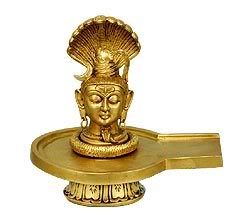
Sivaling literally means the body of Siva. Next to the symbol of AUM, it is perhaps the most potent, powerful and popular symbol in entire Hinduism. In almost all the Siva temples, worship is generally made to Sivalingas only. Very rarely we come across his images in the sanctum sanctorum of any Siva temple. A Sivaling is usually a round or cylindrical and protruding object. The cylindrical part is held firmly by a circular base.
On the physical plane, the object resembles the male sexual organ, suggestive of the creative power of Siva. The circular base resembles that of the female, suggestive of his consort Parvathi. Physically a Sivaling is a phallic symbol, representing the male and female sexual organs in a state of conjugal bliss. Mentally it symbolizes the union of mind and body. Spiritually it represents the union between Purusha and Prakriti, the highest principles of the manifest universe.
The Sivaling is also symbolic of the Supreme Self. It is verily Maheswara Himself, the Highest Self and the Lord of the universe. In this aspect it has three parts. The lower part represents Brahma. The middle part, which is octagonal in shape, represents Vishnu. The upper part, which is cylindrical in shape, represents Rudra and is also called Pujabhaga since it receives the actual offerings of milk and other substances.
The Sivalingas are normally found installed in the temples . But many devotees of Siva keep them in their houses and offer regular worship. People are however cautioned not to keep Sivalingas in their houses without offering worship, since they are believed to be powerful sources of divine energy. Sivalingas are either naturally found or made artificially. Different materials are used in their making, such as clay, gold, crystal, glass, diamonds, precious stones and wood. The round and smooth stones found in the river beds of the Narmada or the Godavari are considered to be the most ideal for worship. Sometimes Sivlingas are made temporarily with clay or sandal paste and disposed of after worship. Some devotees wear Sivalings on their bodies or around their necks. When Sivalings are found fortuitously in the river beds and desolate places, it is considered to be a great omen. They are housed in temples or houses and offered regular worship.
Description of Siva
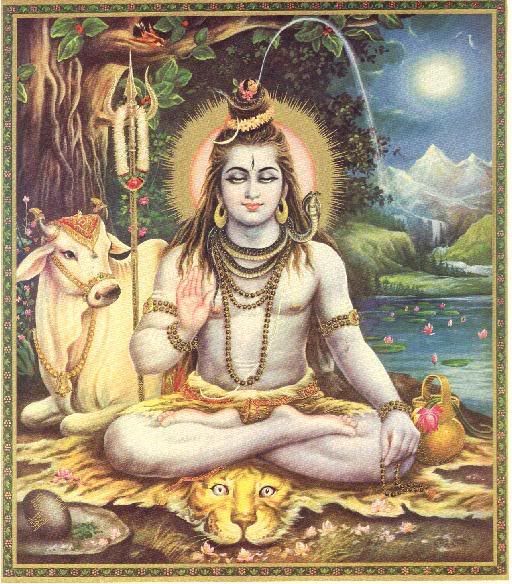
Unlike Vishnu who is depicted as dark blue, Siva is white in color, except for his neck which is dark blue. Images of him in dark blue color is however the norm. He leads a life of severe austerities. But in the images we find him tall and well built. His body is usually besmeared with ashes, denoting his frequent rounds to the cremation grounds. He has three eyes. The third eye rests between his eye brows. It is the eye of wisdom, by opening which he destroys our false selves and our myriad illusions. In contrast to Brahma who is generally depicted as old, Siva is usually shown either as a young or middle aged god.
Though he is described in the scriptures as god of anger, in the images we generally find him in his cheerful and jovial mood. Sometimes he is depicted with a lot of innocence in his demeanor as Bholenath. He is generally shown sitting cross-legged in a yogic posture, with his eyes closed and deep in meditation. When he is shown with his eyes open, his face expresses love and compassion. The images of Siva evoke in us deep emotions. Those who are inclined to worship god are naturally drawn to him as they hold him in their minds.

Unlike Vishnu, who leads a luxurious life, surrounded by opulence, Siva and his family lead austere lives in simple surroundings. He is a god of utter simplicity, exemplary humility and austerity. A tiger skin and an elephant skin serve as his garments. His long matted hair is normally tied into a knot or left flowing. He has four arms. With one he holds his weapon the trident. With another, he holds Damaru, a small drum. The remaining two are held in abhaya and varada mudras (postures).
The tiger and the elephant skin symbolically signify his ability to control and transform animal nature. The trident represents the three qualities, namely sattva, rajas and tamas. The damru denotes his connection with the primal sound AUM, the creation of alphabets, languages, grammar and music. His long matted hair denotes his spiritual life and his great powers. It is also compared to the night sky. He wears a garland of snakes around his neck. Sometimes we see more snakes: one across his body like a sacred thread and two acting as bracelets around his muscular hands. The snakes symbolically represents his control over desire and sensuality. Sometimes in his ferocious aspects, he is shown wearing a garland of skulls. The crescent moon adorns his hair like a silver diadem. And the Ganges flows from his head down into the world below.
Though he is an ascetic, he lives with his family. He is very fond of his consort, Parvathi, whom he married after subjecting her to a lot of tests. While Vishnu is shown as being served by Lakshmi sitting at his feet, Siva and Parvathi are being shown as equals sharing the same seat on the snowy heights of Kailash. Parvathi is literally described as his better half sharing half of his body. This earned him the title ardhanariswara (half female half lord). Normally we find her always by his side, especially when he is seated in Kailash, sharing with him all the honors that he receives.

He seems to dot on his two children, Skanda or Kumara and Lord Ganesha or Vinayaka. The Bull Nandi is his vehicle. Nandiswara is humility personified. He is very knowledgeable also. Nandi taught Hanuman the secrets of Vedas and lessons in humility! Another important member of his retinue is Bhringi, the zealous devotee who was not inclined to worship anyone other than Siva and refused to worship even Parvathi, till he was made to realize his mistake. Although a mountain dweller, he is not attached to anything and true to his ascetic nature, keeps wandering from place to place. Mount Kailash is his abode, where live his family, his devotees who attained liberation and his great army of goblins, imps and ghosts.
Symbolism
We have already explained some aspects of symbolism associated with Siva in the previous paragraphs and in our other articles on Siva and Trinity. Siva symbolically represents the tamasic quality. Because of this he is called pasupathi, (the lord of the animals). His body color which is white, denotes his purity (sivam) and association with the snowy mountains. His three eyes represents the three worlds, the sun, the moon and the earth, the three paths of liberation and the triple nature of creation. The third eye is actually the eye of wisdom or occult knowledge. The moon that adorns his head represents the movement of time and also his cosmic proportions. With the the moon there, his head becomes the night sky, for which he earned the name Vyomakesa (one who has the sky or space as his hair). His association with the moon is in contrast to Vishnu who is associated with the Sun as a solar deity. The moon also symbolizes his association with the occult and the tantras.
Siva is generally a seated yogi, a posture with which most Hindus are familiar. However we also come across Siva as nataraja or tandavamurthi in a dance posture. With his hair flying in all directions and hands and feet in dynamic motion, the image of nataraja is a symbol of harmony and rhythm. Among the objects which are associated with him popularly, apart from the trident and the Damaru, are battleaxe (parasu), rosary (aksamala), pasa (noose), khatvanga (magic wand) and khadga (sword).
Followers of Saivism are familiar with three words: pati, pasu and paasa. Pati is Siva himself, the lord and husband. Pasu is the deluded self that is caught in the cycle of birth and death. Pasa is the bond that binds the pasu to this world and it gains liberation through devotion and surrender to pati.
Aspects of Lord Siva
Siva is known by several names and worshipped in various forms. We are mentioning below some of his most famous aspects:
Panchanana Siva: In some temples Siva is shown with five faces. Each of the faces has a name and represents a specific aspect. These five faces are Isana, Tatpurusa, Aghora, Vamadeva and Sadyojata. Isana faces south east and represents Iswara aspect of Siva known as Sadasiva, or the Eternal Siva. Tatpurusha faces the east. He is Siva in his aspect as a deluded purusha or ego. Aghora faces the south and represents the destructive and regenerative aspect of Siva that, like fire, first devours life and then prepares the ground for its renewal. Vamadeva faces north. He is healer and preserver. Sadyojata faces west and represents the creative power of Siva.
Anugrahamurthy: This is the milder or peaceful aspect of Lord Shiva when he is in the company of his beloved devotees or his family members.
Ugramurthy: Also known as Raudra , Bhairava, Kankala or Samharamurthy, this is the ferocious or angry form of Siva, generally associated with the events during which Siva assumed his terrible form to slay the demons or the wicked. The following are his well known terrible forms:
• Kankala-bhairava: The form which he assumed after cutting off the fifth head of Brahma
• Gajasura-vadha-murthy: The form he assumed while killing a demon named Nila
• Tripurantakmurthi: The form he assumed while destroying the three cities of gold, silver and iron built by the three sons of Andhakasura
• Sarabhesa-murthy: The form in which he allegedly fought and killed, Narasimha, the incarnation of Vishnu.
• Kalari-murthy: the form in which he fought and defeated Yama to save his devotee Markandeya.
• Kamantaka-murthy: The form in which he destroyed Manmadha, the god of lust, for disturbing him while doing penance.
• Andhakasura-vadha-murthy: The form in which he defeated Andhakasura, who subsequently joined his forces as his commander and became popular as Bhringi.
• Bhairava-murthy: The form generally found in connection with the secret cults of Tantricism that involve his worship in the cremation grounds and grave yards.
Tandavamurthy: Lord Siva is a master of dance forms. He is the author of all dance forms. The science of dance ( Natyasasthra) dealing with the 108 types of classical Indian dance forms said to have originated from him just as all the yogic postures. In case of Lord Siva all dance is a form of expression, which he uses either to relieve the tensions in the world or alleviate the sufferings of his devotees. Sometimes he also entertains the gods or his wife or his devotees with his dance. About nine forms of Siva in dancing mode are described, of which the most popular form is Nataraja (the king of dance). Though we have a number of icons of Siva as Nataraja, he is rarely worshipped in this form either in the temples or in the households. His other dance forms include, Ananda-tandava-murhty, dancing in a pleasant and cheerful mood, Uma-tandava-murhty, dancing in the company of Parvathi, Tripura-tandava-murthy, dancing while slaying Tripurasura and Urdhva-tandava-murhty, dancing in the air.
Symbolism of Nataraja:
Nataraja literally means lord of the dance. Siva is the lord, the ultimate and effective cause of all creation and the dance is his act of creation, a dynamic rhythmic movement. His dance is a guided action, under his complete mastery, not an act of chaotic, random movements. The lord and the dance together constitute the projection of the Paramasiva, the highest eternal and formless Nirguna Brahman on the canvas of his own awakened state as Saguna Brahman.
Every aspect in the image of Nataraja represent an aspect of creation. The lord is surrounded on all sides by a circular ring of fire. The ring represents the whole of creation. It is finite, cyclical and filled with energy or shakti shown here as flames. It ensues from the hands and limbs of the Lord suggestive of the fact that he is the primal and effective cause of creation.
Nataraja holds a tongue of flame in his upper left hand. The fire represents the energy that is responsible for creation and also the dissolution of the worlds at the end of creation. As a creator he creates, upholds and also destroys the worlds.
The upper right hand holds a drum or damaru which is a musical instrument that produces rhythmic sounds. It is suggestive of the sound of breath, the sound of life, the vibrations underlying all currents of creation and manifestation. It also represents the vibrations that arise from our thoughts, emotions, mental activity, movement of the senses and the very samsara in which the jivas continue their existence till they find an escape.
The lower left hand is held in an assuring mode (abhaya-mudra) suggesting that the jivas need not have to despair and that they can escape from the impurities of samsara (anava, karma and maya) and achieve sameness (saujya) with Siva through his grace (anugraha) and intervention. The second right hand is shown pointing towards the downside with the palm upside drawing our attention to the figure lying beneath his feet suggesting that the lord is not holding anything back but revealing the knowledge of creation and the secrets of our bondage so that jivas can find means of escape through the assurance they find in his lower left hand.
The matted hair of Siva is shown as flying high and flowing in all directions. These are the symbols of divinities or the higher gods who live in the higher realms and participate in the cosmic dance enacted by Lord Siva. The tiger skin worn by the deity suggests that even God has respect for the rules of right conduct and the dharma he has established in the manifest creation for the guidance of the souls. The snake around his waist enjoying the dance with a raised hood is suggestive of the kundalini-shakti that remains ever awakened in Siva and is in unison with him.
The dwarf lying at the feet of the dancing nataraja is known as apasmara-murthy. It symbolically represents the jiva that has forgotten about its own infiniteness and its Siva nature because of the impurity of anava which makes it believe it to be a dwarf or anu (atomic or minute or finite being) and become a subject of the dance of creation.
Thus we can see that the image of nataraja is an iconic representation of the whole Saiva Siddhanta philosophy one of the most ancient schools of Saivism. The various aspects of the image represent the nature of Siva, the act of creation, the state of the jivas and the means of liberation. By creating it or serving it or by contemplating upon it one can initiate the process of liberation through the grace of Siva.
Dakshinamurthy: This is Siva in his aspect as the universal teacher, teaching the secrets of yoga, tantras, yantras, alchemy, magic, occult knowledge, arts and sciences, ancient history or knowledge of the future to the sages and saints, gods and goddesses and his highly qualified devotees. He is called Dakshinamurthy, because he does his teachings sitting on the snowy mountains of Himalayas and facing towards the Indian subcontinent, which is in the southerly direction. The images of Dakshinamurthy, depict Siva in his pleasant mood, seated on a high seat, with one leg folded while the other rests on the Apasmarapurusha, the deluded self. Two of his arms hold a snake or rosary or both in one hand and fire in the other. The snake is a symbol of tantric knowledge and the fire symbol of enlightenment. Of the remaining two one is in abhayamudra (posture of assurance) and the other holds a scripture in gnanamudra (posture of presenting knowledge).
Lingodhbhava-murthy: This image signifies the importance of Siva in the form of Linga as the Supreme Self, without a beginning and without an end. According to Hindu mythology, Siva once revealed his infinity to Brahma and Vishnu in the form of a pillar of fire that could not be scaled by either of them from one end to the other. As Lingodhbava-murthy, Siva appears seated in the heart of a Linga, with four arms, while Brahma and Vishnu adore him from the two sides.
Bhikshatana-murthi. This is Siva in his ascetic aspect, wandering from place to place, with a begging bowl made of human skull, doing penance or lost in his own thoughts. Even today we can see some followers of Siva going around the villages in India in this form. Some of them even do a little magic to attract our attention or scare away the trailing children.
Hridaya-murthy: This is Siva in a mood of reconciliation and friendship with Vishnu. Also known as Harihara or Sankaranarayana. The images show the right half of Shiva on the right side of the image and the left half of Vishnu on the left side.
Ardhanariswara: This Siva and Parvathi together in one form signifying the unity of Purusha and Prorate. The feminine left half of Parvathi is fused with the masculine right half of Siva in one continuous form, sometimes standing with the Bull Nandi in the background, or sitting on a pedestal and blessing the worlds, with eyes open or closed.
Minor Deities of Siva
The minor deities are part of Siva's Retinue. Among them the most important are Nandi, Bhringi, Virabhadra and Chandesvara.
Nandi: It is interesting to note that unlike the Vedic people who regarded the cow as sacred animal, the followers of Siva venerate the bull! It is because Nandi, the Bull, is Siva's vehicle. Nandi is invariably found sitting right infront of the sanctum sanctorum in every siva temple facing the image and looking at him all the time. In fact no one is supposed to see the chief deity in a siva temple without paying homage first to the seated Nandi and looking at Siva from afar through the space between the ears and the top of his head. There are some temples in India which are exclusively built for him like the famous Nandiswara temple in Karnataka. Nandiswara in his anthromorphic form appears just like Siva, with three eyes and four hands of which two are permanently dedicated to the veneration of Siva while the other two carry his weapons. Symbolically Nandi represents the animal or the tamasic qualities in man which Siva rides and transforms with his energies. As we have already noted, Nandi is well versed in all scriptural knowledge and spiritual knowledge and imparted knowledge of devotion to Hanuman. It is a tradition in many parts of rural India to let a Bull roam free in each village as a mark of respect to Nandi and to inseminate the cows in the village.
Bhringi: He was originally a demon named Andhaka, who was transformed by Siva into a humble devotee and admitted into his force as a commander of his armies. Bhringisa was so loyal to Siva that in his state of devotion he would not offer his worship to any one including Parvathi. It is said that when he saw once Siva in his Ardhanariswara form, he tried to bore through the middle of the body in the form of a bee to complete his obeisance to only the Siva side of the form, much to the annoyance of Parvathi. Bhringi who got his name thus was made to realize his mistake and change his behavior by Lord Siva.
Virabhadra He is Siva in his ferocious mood. Siva manifested himself as Virabhadra, when Daksha, his father in law, ill treated and insulted his wife Sati, Daksha's own daughter, infront of a large gathering. Unable to cope with the insult, Sati immolated herself. This angered Siva so much, that he descended upon the place of Daksha with his large army and beheaded Daksha's. The images of Virabhadra depict the anger and ferocity of Siva in that destructive mood, wearing a garland of skulls, and with four arms holding four different kinds of weapons. Virabhadra is a warrior god who was worshipped during wars in ancient and medieval periods. He is also the principal deity of Virasaiva movement and still worshipped by many in the Karnataka region of India.
Chandesvara He is an aspect of Chandi in human form later elevated to the status of divinity, to signify the connection between Siva and Chandi, or Durga. Chandesvara is a ferocious god, holding weapons of war and ready to do battle for a divine cause. His images are generally found in a corner in all the Siva temples. As in case of Nandi, devotees usually visit him and pay their respects before going to see the Sivaling in the sanctum sanctorum.
| Ashtmoorty upasna mandal. |
|